
 EN
EN
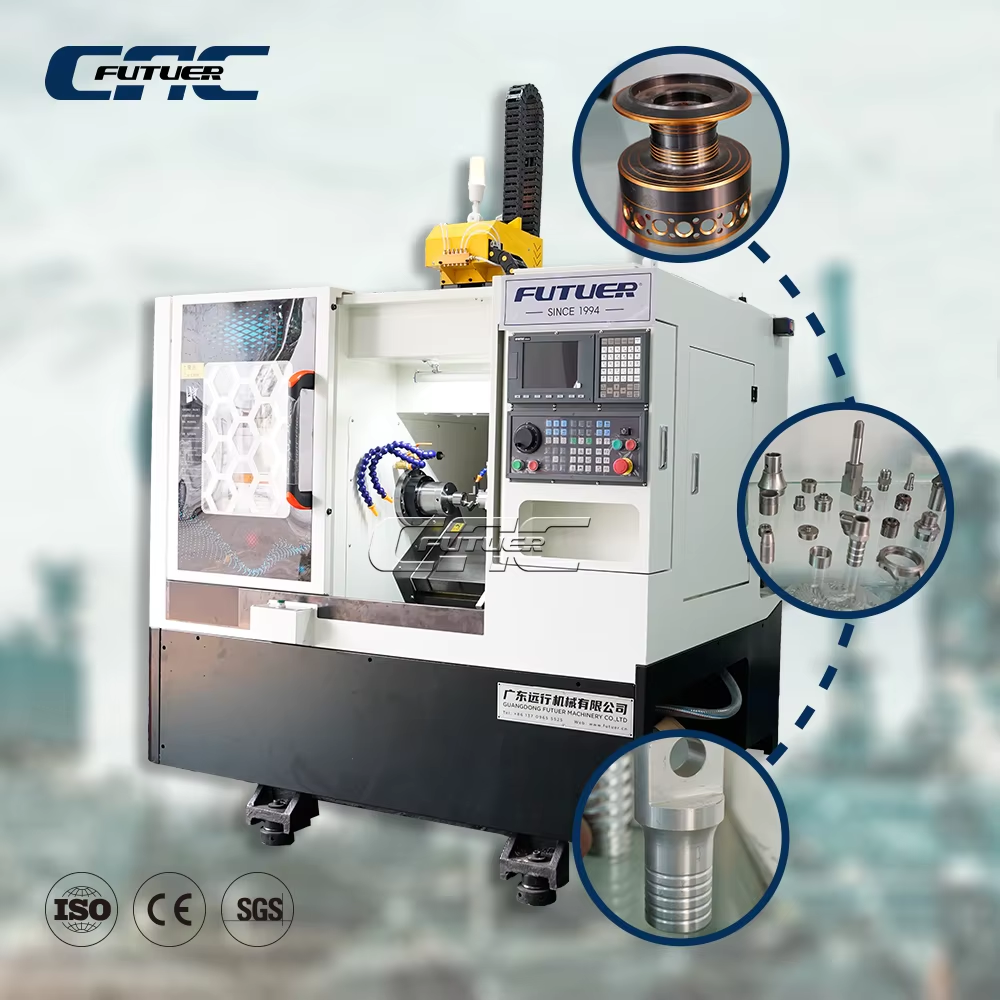
Syntec Lathe Core Capabilities: Control Architecture and Real-World Performance
How Syntec’s CNC Control Compares to Fanuc and Siemens in Precision, Responsiveness, and Ease of Use
Syntec controllers deliver a distinct balance of speed, accuracy, and operator accessibility compared to industry stalwarts. In real-time multi-axis computation, Syntec executes up to 10,000 calculations per second—more than double the 3,000–5,000 typical of conventional controllers (2024). This computational headroom translates directly into smoother motion profiles and minimal toolpath delay during complex contouring. Its error compensation system corrects deviations within 0.01 mm—five times tighter than the 0.05 mm common among alternatives—while an 80% reduction in signal interference preserves micron-level precision even in electrically noisy shop environments. As a result, surface finishes consistently achieve Ra 0.8 µm on contoured parts—a benchmark many legacy systems struggle to replicate without multiple setups or manual rework.
Ease of use remains a defining advantage. Operator surveys show 90% of new users reach functional proficiency within one week—less than half the two- to three-week ramp-up often required for competing platforms. The graphical, menu-driven HMI lowers entry barriers without sacrificing depth, offering intuitive navigation alongside full parameter access. Combined with its cost-effectiveness, this makes Syntec a pragmatic choice for workshops seeking high-fidelity multi-axis control without the premium pricing of flagship brands.
Syntec-Specific Advantages: G-code Flexibility, Intelligent Toolpath Optimization, and Seamless Multi-Axis Sync
Syntec’s architecture prioritizes programmer agility through native G-code flexibility. Direct macro programming and seamless custom post-processor integration let shops adapt cycles to unique geometries—cutting hand-coding time significantly. Its intelligent toolpath optimization leverages that 10,000-calculations-per-second engine to analyze and smooth trajectories in real time. In a documented shoe mold application, one-time clamping of irregular shapes became feasible, reducing total processing time by 30% while maintaining Ra 0.8 µm surface finish—a result unattainable with traditional setups requiring multiple re-fixturings.
Multi-axis synchronization is equally robust: the controller ensures lag-free coordination across 4- and 5-axis motions, enabling intricate simultaneous turning-milling operations. Rapid interpolation, coupled with strong anti-interference design and streamlined code execution, minimizes vibration and tool wear—even under demanding multi-channel program loads. For shops scaling from basic CNC operations, Syntec offers a proven, accessible on-ramp to advanced manufacturing—delivering measurable gains in both precision and productivity from day one.
Matching Syntec Lathe Specifications to Your Workshop Requirements
Selecting a Syntec lathe begins with aligning its physical and power attributes precisely to your production scope. A mismatch risks costly bottlenecks; data indicates 68% of workshops upgrade within three years due to initial size limitations, incurring over $50,000 annually in avoidable downtime (Modern Machine Shop, 2024). The following analysis breaks down core specifications to ensure your investment delivers immediate and sustained throughput.
Physical Envelope & Capacity: Swing Over Bed, Spindle Bore, and Center Distance Calculations
The physical envelope defines the largest part dimensions a Syntec lathe can process reliably. Swing over bed—the maximum workpiece diameter that clears the machine structure—is foundational. A 15-inch swing accommodates approximately 85% of common automotive and general engineering components. However, energy or aerospace applications exceeding 800 mm in diameter require heavy-duty models with reinforced beds and extended structural rigidity.
Spindle bore diameter determines bar-stock feeding capability: larger bores eliminate pre-cutting steps and support continuous production of long, slender parts. Center distance—the maximum length between headstock and tailstock—sets the upper limit for shaft-like workpieces. When machining a 40-inch shaft, the bed must accommodate not only the part but also tooling clearance and dynamic motion safety margins. Evaluating swing, bore, and center distance together ensures the machine’s working envelope fits both your largest and most frequently produced parts—without compromise.
Power & Material Compatibility: Torque, Speed Range, and Performance on Aluminum, Stainless Steel, and Hardened Alloys
Power delivery must match material resistance. High-speed spindles (8,000+ RPM) excel with soft metals like aluminum, enabling rapid material removal and fine finishes. Machining stainless steel or hardened alloys demands high torque at lower RPMs to sustain cutting force without stalling tools or inducing chatter. Syntec’s flexible G-code and intelligent toolpath optimization dynamically adjust feed rates, spindle speeds, and acceleration profiles to maintain optimal chip load across material transitions.
A broad torque curve—especially peak torque available across a wide RPM range—combined with a rigid drive system allows seamless switching between delicate aluminum components and tough stainless shafts in a single run. Reviewing the motor’s continuous torque rating and the RPM band where peak torque is delivered ensures the lathe handles your most demanding materials without sacrificing tool life, dimensional stability, or surface integrity.
Long-Term Value of Your Syntec Lathe Investment
Serviceability, Firmware Update Cadence, and Backward Compatibility Across Syntec Generations
Long-term value hinges on serviceability, update discipline, and generational continuity. Annual maintenance costs typically reach 10–15% of the machine’s purchase price—for a $80,000 lathe running two shifts, that equates to roughly $12,000 per year (2023 industry data). Shops adopting preventive service agreements and scheduling regular firmware updates extend operational life by 3–5 years versus reactive repair strategies alone. Critically, Syntec maintains backward compatibility across control generations: existing G-code programs, proven toolpath libraries, and custom macros remain fully functional after hardware upgrades. This protects your intellectual investment in programming and eliminates costly rework—lowering total cost of ownership and sustaining productivity well beyond the baseline warranty period.
Local Technical Support Availability and Authorized Service Network Coverage
Even the most reliable hardware depends on responsive local support. Leading providers guarantee technician arrival within 48 hours under standard warranty terms—minimizing downtime when every lost hour impacts profitability. Authorized service centers staffed exclusively with Syntec-certified engineers ensure firmware diagnostics, parameter tuning, and hardware repairs are performed correctly the first time. Before purchase, verify coverage maps and documented response SLAs: proximity to an authorized center directly reduces mean time to recovery and sustains high machine utilization rates.
Syntec Lathe Usability Across Skill Levels
Beginner-Friendly Features: Guided Setup Wizards, Visual Programming Aids, and Intuitive HMI Design
Syntec flattens the learning curve with purpose-built onboarding tools. Guided setup wizards walk operators step-by-step through initial configuration—including automatic tool offset calibration and workpiece zero-point determination—eliminating manual calculation errors. Visual programming aids replace raw G-code entry with drag-and-drop toolpath generation, accelerating part programming while reducing syntax-related faults. The high-resolution touchscreen HMI uses consistent iconography and logical menu hierarchies, enabling rapid comprehension and confident navigation. As confirmed by a 2023 operator usability survey, 90% of new users achieve basic operational proficiency within one week—significantly faster than legacy platforms. This accessibility cuts training time, accelerates production ramp-up, and supports cross-training across shift teams.
Advanced Capabilities: Direct G-code Editing, Macro Programming, and Custom Post-Processor Integration
For experienced machinists, the same platform unlocks deep control functionality. Direct G-code editing includes real-time syntax checking and line-by-line simulation—enabling precise, on-machine toolpath refinement. Macro programming supports parameter-driven routines, conditional logic, and nested subroutines, automating complex, repetitive tasks such as multi-pass threading or adaptive roughing. Seamless custom post-processor integration ensures clean, optimized code transfer from leading CAM systems—critical for high-mix, low-volume production where manual code edits would be impractical. These advanced features coexist with the beginner-friendly interface, delivering enterprise-grade multi-axis synchronized turning capability without compromising accessibility.
FAQ: Frequently Asked Questions
What are the core advantages of Syntec CNC controllers?
Syntec CNC controllers excel in precision, responsiveness, and ease of use. They offer high computational power, tight error compensation, and beginner-friendly features like guided setup wizards, intuitive HMI, and advanced programming capabilities.
How does Syntec compare to Fanuc and Siemens controllers?
Syntec delivers smoother motion profiles, superior error correction, and shorter operator ramp-up times. While slightly less established than Fanuc and Siemens, Syntec focuses on accessibility without compromising advanced capabilities.
What materials can Syntec lathes handle?
Syntec lathes handle a broad range of materials, including aluminum, stainless steel, and hardened alloys, providing high torque and adjustable settings for optimal performance.
Are Syntec controllers suitable for multi-axis operations?
Yes, Syntec controllers are robust in multi-axis synchronization, enabling precise simultaneous turning-milling operations while minimizing vibration and tool wear.
Does Syntec offer backward compatibility?
Yes, Syntec ensures compatibility across generations, allowing existing G-code programs and toolpath libraries to remain functional after hardware upgrades.