
 EN
EN
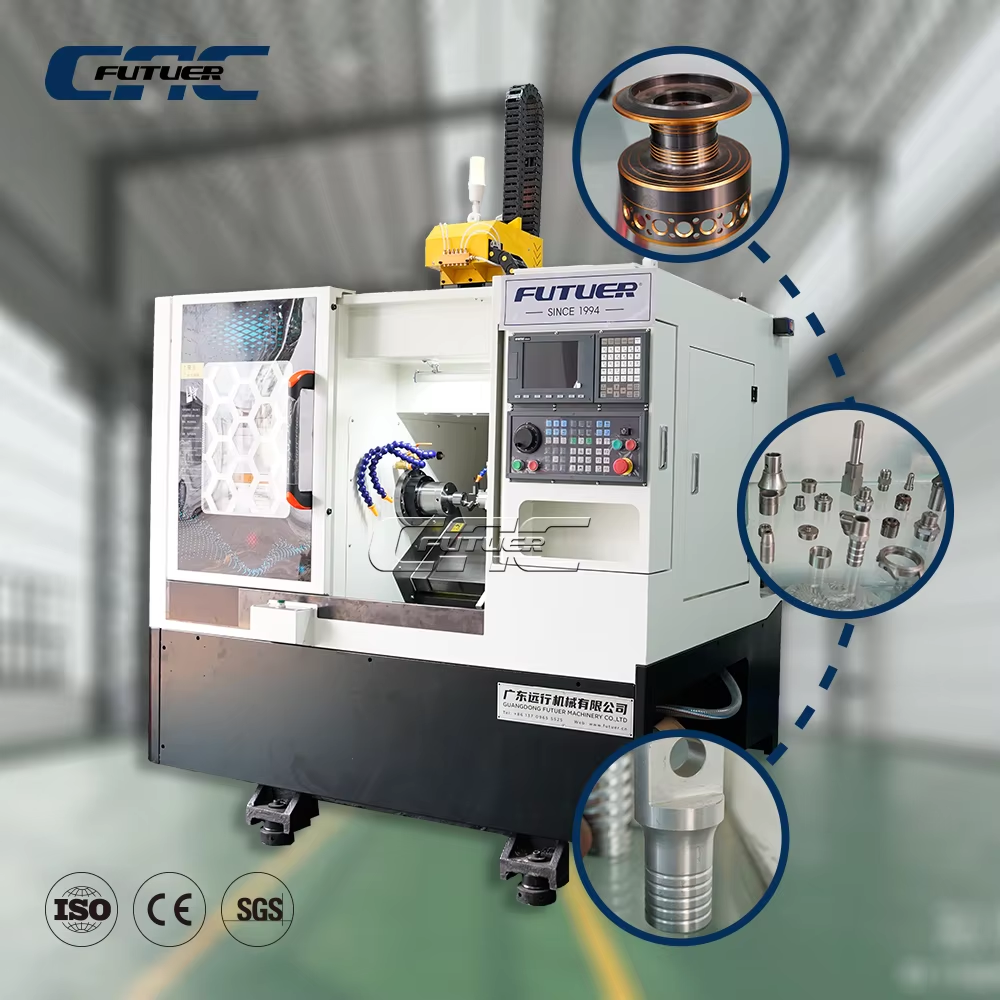
Fanuc Lathe Intelligence: Real-Time Precision and Adaptive Control
Real-time adaptive control and servo tuning for dynamic error compensation
Fanuc lathe systems continuously analyze cutting forces, spindle loads, and axis positions through high-speed digital servo loops. The control instantly adjusts feed rate and spindle speed to compensate for tool deflection, material inconsistencies, and thermal shifts—maintaining process stability without operator intervention. Dynamic servo tuning—powered by HRV+ and vibration-filter algorithms—automatically modifies gains and notch filters in microseconds, suppressing chatter before it affects surface finish. Rather than relying on static offsets, the CNC learns from real-time feedback, predicts drift, and corrects trajectory errors on the fly. This adaptive compensation sustains geometric tolerance as tools wear, delivering consistent surface finish and dimensional accuracy—even during long, unattended runs. As a result, operators no longer pause production for manual tuning; the control itself maintains process capability well within micron-level specifications.
G-code execution to nanometer-level positioning accuracy in Fanuc lathe systems
A dedicated look-ahead engine pre-processes hundreds of G-code blocks, computing optimized acceleration and jerk profiles. Paired with high-resolution absolute encoders—often delivering 16 million counts per revolution after interpolation—the servo drive resolves axis movement down to single-nanometer increments. Fanuc’s AI Contour Control (AICC), activated via G05.1 Q1, offers ten levels of speed-versus-accuracy balancing:
| Setting | Speed‑vs.‑accuracy balance | Typical use case |
|---|---|---|
| R1–R2 | Maximum speed, lower accuracy | Rough turning |
| R3–R5 | Balanced speed and form precision | Die & mold semi‑finish |
| R6–R8 | Higher accuracy, controlled motion | Precision finishing |
| R9–R10 | Sub‑micron accuracy, minimal smoothing | Ultra‑fine finishing |
With G61 exact stop mode, axes achieve full positioning at every command point—eliminating corner rounding. When intricate profiles demand nanometer-level fidelity, these modes let shops precisely balance cycle time against form error. Combined with nano-interpolation and rigid servo response, Fanuc lathes support true 5-axis simultaneous contouring without compromising dimensional integrity.
Twin-Turret & Dual-Path Fanuc Lathe Architecture: Maximizing Throughput
Simultaneous multi-operation machining—bevel turning, drilling, threading—in single setups
Fanuc’s dual-path CNC architecture enables independent, synchronized control of upper and lower turrets—allowing bevel turning, drilling, and threading to execute concurrently on a single workpiece. This eliminates multiple setups and manual part transfers, collapsing production sequences into one uninterrupted cycle. Real-time interpolation and collision-avoidance algorithms coordinate tool paths with sub-millisecond precision, enabling overlapping cuts that minimize idle time. For example, while one turret rough-turns an outer diameter, the other drills and chamfers internal bores simultaneously. The result is a dramatic reduction in non-productive “air cut” movements and tool-change delays—manufacturers routinely achieve 30–50% cycle-time reductions versus sequential operations, while maintaining tight tolerances through integrated dynamic servo tuning. Integrated C-axis and live tooling extend capabilities further, supporting off-center milling and keyway cutting—all within a single clamping. By eliminating datum shifts between setups, this architecture improves part consistency and supports high-mix, high-volume production of precision components.
Seamless Automation Integration: From Robot Loading to Industry 4.0 Readiness
FANUC FIELD system integration for predictive maintenance and OEE optimization on Fanuc lathe lines
The true power of a modern Fanuc lathe emerges when it functions not as a standalone machine—but as an intelligent, connected node within a smart factory. This transformation is enabled by seamless integration of robotic loading systems with the FANUC FIELD (FANUC Intelligent Edge Link and Drive) platform. FIELD aggregates high-resolution data from the lathe’s control, servo drives, and integrated robot arms—analyzing it at the edge to predict component degradation before failure occurs. This shifts maintenance from reactive or calendar-based schedules to condition-based, predictive strategies. Aggregated performance data from a global electronics manufacturer (2023) shows this approach delivers a 14% improvement in Overall Equipment Effectiveness (OEE) on fully integrated lines. FIELD also enables adaptive machining: robots can automatically adjust infeed parameters based on in-process metrology feedback, ensuring first-pass yield without human intervention. From raw material loading to finished-part palletization, this closed-loop automation creates lights-out manufacturing—maximizing spindle utilization while minimizing in-process inventory.
Proven Impact Across High-Stakes Industries
Medical: Sub-micron repeatability and full traceability for orthopedic implants
In orthopedic implant manufacturing, even a 1-micron deviation risks implant loosening or premature wear. Fanuc lathe technology achieves sub-micron repeatability (±0.3 µm) through advanced servo tuning and nanometer-level positioning—ensuring precise articular surfaces on hip stems and acetabular cups. This precision is validated by in-process probing and automatic tool offset correction. Beyond accuracy, full traceability is mandatory. Fanuc controls generate a complete digital twin of each machining cycle—capturing all cutting parameters, vibration signatures, and thermal profiles—to meet ISO 13485 and FDA requirements. This comprehensive data package enables rapid root-cause analysis and virtually eliminates batch recalls, making Fanuc lathes indispensable for life-critical medical components.
Aerospace & automotive: 42% cycle time reduction and 27% higher OEE vs. legacy controls
Switching from legacy controls to Fanuc lathe systems has delivered a 42% reduction in cycle time and a 27% increase in OEE across aerospace and automotive applications (Global Machining Benchmark 2024). The twin-turret, dual-path architecture enables simultaneous turning, drilling, and threading on turbine disks or transmission shafts—collapsing multi-setup processes into a single operation. Look-ahead contour control and adaptive thermal compensation preserve sub-micron dimensional accuracy over extended runs of complex parts. Tier-one suppliers report that one Fanuc lathe now replaces two older machines—reclaiming floor space and reducing energy consumption by 15%.
FAQ Section
-
What is dynamic error compensation in Fanuc lathes?
Fanuc lathes use real-time servo tuning and adaptive control to instantly adjust feed rates, spindle speeds, and other parameters to account for tool deflection, material inconsistencies, or thermal shifts. -
How does Fanuc enable nanometer-level precision?
Fanuc's dedicated look-ahead engine and 16-million-count absolute encoders resolve axis positioning down to nanometer increments, ensuring extreme accuracy. -
What benefits does dual-path architecture offer?
The twin-turret design allows simultaneous machining operations, reducing cycle times by 30–50%, improving throughput, and maintaining precise tolerances. -
How does Fanuc support Industry 4.0 readiness?
Through FANUC FIELD integration, lathes function as smart factory nodes for predictive maintenance, adaptive machining, and automated production optimizations. -
Can Fanuc lathes improve production in high-stakes industries?
Yes, Fanuc technology ensures sub-micron precision and full traceability for industries like medical, aerospace, and automotive without compromising performance.