
 EN
EN
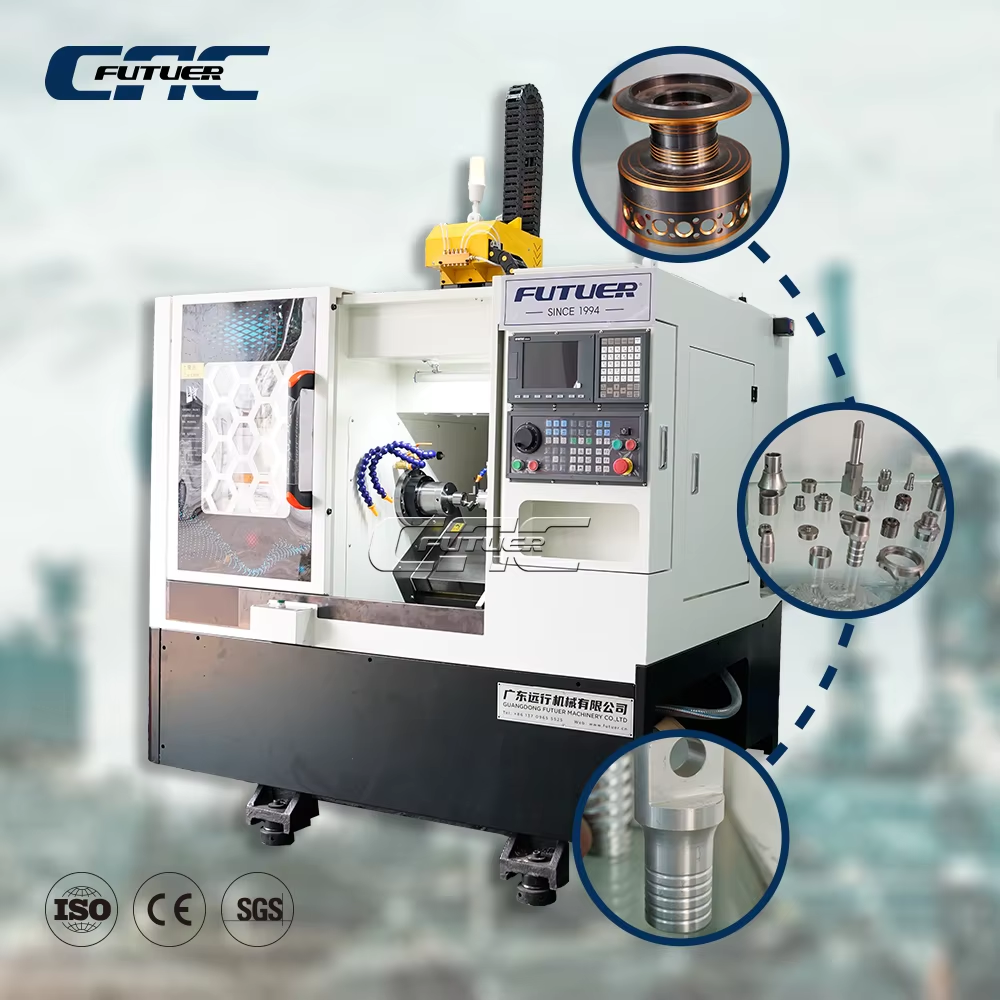
Fanuc Lathe: The Industry Benchmark for Intelligent Automation
The Fanuc lathe redefines intelligent automation by embedding real‑time AI analytics and a unified CNC (Computer Numerical Control) architecture that seamlessly coordinates cutting processes, robotics, and sensor feedback. This capability not only elevates precision but also creates a scalable foundation for lights‑out manufacturing.
AI-Driven Real-Time Monitoring and Adaptive Parameter Adjustment
Modern CNC lathes must react to dynamic conditions such as tool wear, thermal expansion, and material inconsistencies. Fanuc lathes employ deep reinforcement learning models that continuously monitor spindle speed, feed rate, and axis orientation during cutting. By analyzing these variables in real time, the system detects deviations from optimal performance and automatically adjusts parameters to prevent anomalies and equipment failure. This adaptive control extends tool life, reduces scrap, and ensures dimensional accuracy—even during extended production runs. Unsupervised machine learning enables the lathe to learn from each cycle, progressively refining its behavior without manual reprogramming. The result is a machine that maintains sub‑micron tolerances while anticipating issues before they impact quality—delivering data‑driven confidence in zero‑defect production.
Seamless Integration of Sensors, Robotics, and CNC Control Architecture
The Fanuc lathe’s control system is engineered for native interoperability with vibration sensors, thermal probes, acoustic emission detectors, and robotic handlers—transforming a standalone turning center into a fully automated production cell. Live sensor data feeds directly into the CNC, which orchestrates robotic load/unload sequences and in‑process inspection in closed-loop fashion. This eliminates manual intervention, shortens cycle times, and enables continuous unattended operation. In integrated deployments, manufacturers report up to 15 % efficiency gains from synchronized workpiece flow and real‑time adaptive adjustments. Built on Industry 4.0 protocols, the platform supports remote monitoring and predictive analytics—consolidating motion control, sensor fusion, and robotic coordination into a single, secure interface. That unified architecture simplifies cell deployment, accelerates time‑to‑market for complex parts, and preserves granular control and safety whether scaling from one machine to a multi‑machine line.
Sub-Micron Precision: How Fanuc Lathe Delivers Unmatched Accuracy
Thermal Error Compensation and Dynamic Tool Wear Prediction
Thermal expansion remains a leading cause of dimensional drift in high-precision machining. Fanuc lathes counteract this with embedded temperature sensors in the spindle, ball screws, and machine structure. Real-time thermal data feeds a proprietary compensation model that predicts positional drift and dynamically offsets axes—maintaining accuracy within ±1–2 µm even during prolonged high-speed cycles. Complementing this, dynamic tool wear prediction analyzes cutting force, spindle load, and acoustic emission signatures to estimate instantaneous insert wear. The system then adapts feed rates and depth of cut to preserve surface finish and geometric fidelity, issuing proactive tool-change alerts before tolerance limits are breached. This closed-loop intelligence sustains stable, unattended sub-micron production—reducing scrap and eliminating guesswork in process planning.
Repeatability, Surface Finish, and GD&T Compliance in Production
Repeatability is foundational to Fanuc’s mechanical and control design. Linear scales with nano-interpolation and high-rigidity ball screws deliver bidirectional positioning repeatability consistently below ±0.002 mm. Surface finish benefits from AI Contour Control (AICC), particularly G05.1 Q1 R9–R10 modes, which prioritize path accuracy over speed—enabling Ra 0.4 μm finishes routinely, often without secondary polishing. For GD&T compliance, the lathe goes beyond diameter tolerances: in-process probing combined with temperature-compensated movements ensures tight control over circularity, cylindricity, and total runout—even across large batches. This integrated capability minimizes reliance on off-line inspection and provides verifiable, print-aligned conformity for every part.
Scalable Automation Without Compromise: From Standalone Fanuc Lathe to Smart Manufacturing Cells
Scaling automation in precision machining demands a platform that maintains consistency and intelligence across configurations—from a single machine to a full smart manufacturing cell. The Fanuc lathe is built on a modular, integration-ready architecture with standardized interfaces, interchangeable fixturing, and a common CNC control backbone. This allows manufacturers to begin with one validated turning center and expand seamlessly into flexible cells incorporating robotic loaders, AGVs, and central storage towers—without re-engineering core processes or re-validating parameters.
The same real-time monitoring, tool-wear algorithms, and adaptive control strategies governing a standalone lathe extend natively to the cell level—preserving sub-micron precision and surface finish quality. As demand shifts, the system supports mixed-model scheduling with minimal downtime, automatically retooling and reconfiguring based on digital orders from the MES. Scalability here means more than adding hardware: it’s about growing a self-correcting, quality-protected automation environment—where reliability, uptime, and conformance are guaranteed from the first prototype to high-volume production.
Maximizing Uptime: Predictive Maintenance and Closed-Loop Feedback on Fanuc Lathe Systems
Vibration and Acoustic Emission Analytics for Early Failure Detection
Fanuc lathes leverage high-frequency vibration and acoustic emission analytics to detect incipient failures—such as spindle bearing degradation, gear mesh anomalies, and emerging tool chatter—long before they trigger unplanned stops. Unlike time-based maintenance schedules, this closed-loop system identifies subtle signal deviations missed by conventional inspections. Real-time insights feed directly into the CNC, enabling automatic parameter adjustments or intelligent scheduling of service during planned pauses. According to a 2024 Deloitte study, predictive maintenance powered by such analytics cuts unplanned downtime by 40% and lowers maintenance costs by 25%. On the Fanuc platform, this transforms maintenance from reactive repair into a proactive, uptime-maximizing discipline—one grounded in empirical data and operational continuity.
Frequently Asked Questions (FAQ)
What makes the Fanuc lathe unique in intelligent automation?
The Fanuc lathe integrates AI-driven analytics, CNC architecture, and real-time sensor feedback to optimize precision machining and enable lights-out manufacturing.
How does the lathe achieve sub-micron accuracy?
Fanuc lathes use thermal error compensation, adaptive tool wear prediction, and dynamic axis offsetting to maintain accuracy within ±1–2 µm during extended cycles.
Can the Fanuc lathe operate in automated manufacturing cells?
Yes, the modular architecture allows seamless integration with robotic handlers, AGVs, and centralized storage systems for scalable automation.
What predictive maintenance features does the system offer?
Fanuc lathes utilize vibration and acoustic emission analytics to detect early machine issues, preventing unplanned downtime and reducing maintenance costs.
Table of Contents
- Fanuc Lathe: The Industry Benchmark for Intelligent Automation
- Sub-Micron Precision: How Fanuc Lathe Delivers Unmatched Accuracy
- Scalable Automation Without Compromise: From Standalone Fanuc Lathe to Smart Manufacturing Cells
- Maximizing Uptime: Predictive Maintenance and Closed-Loop Feedback on Fanuc Lathe Systems
- Frequently Asked Questions (FAQ)