
 EN
EN
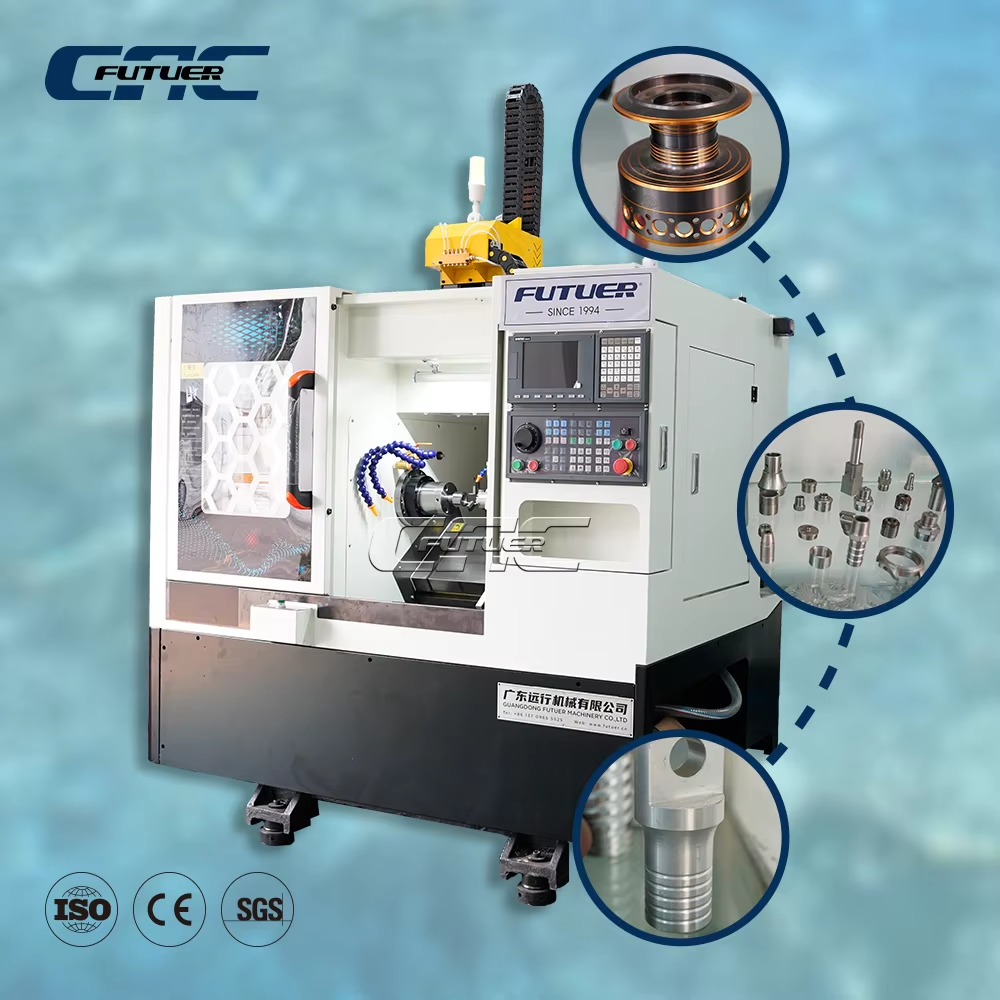
Precision Engineering: How Slant Bed CNC Lathe Geometry Enables Sub-Micron Accuracy
A slant bed CNC lathe’s inclined bed design is the foundation of its ability to deliver sub‑micron accuracy in advanced turning operations. Unlike flat‑bed configurations, the angled construction optimizes force distribution, gravity‑assisted chip removal, and thermal management—essential factors for maintaining tight part tolerances across long production cycles.
Bed Angle Optimization (30°, 45°, 60°) and Its Direct Impact on Positional Repeatability & Thermal Error Compensation
Selecting the appropriate bed angle is a critical lever for achieving repeatable sub‑micron precision. A 30° slant is favored for small, lightweight components; the gentle incline permits stable cutting with minimal deflection, while excellent chip evacuation and rapid heat dissipation keep thermal errors to ±1 µm over short runs. For medium‑sized workpieces, a 45° orientation offers the most balanced performance. It aligns the resultant cutting force with the machine’s main structural axes, reducing torsional flex and improving positional repeatability. The 45° geometry also accelerates coolant and chip flow away from the cut zone, maintaining a consistent thermal state that limits spindle growth and tailstock misalignment. When machining heavy parts or during aggressive material removal, a 60° slant bed dominates. The steep inclination maximizes gravity’s role in clearing chips and cutting fluids, preventing the re‑cutting that generates heat spikes and surface damage. This angle significantly lowers local temperature gradients along the Z‑axis, reducing the need for complex active compensation algorithms. As a result, the machine sustains ±1 µm positional repeatability throughout high‑volume shifts—effectively neutralizing the primary causes of thermal distortion.
Real-World Metrology Validation: <2 µm Roundness and ≤0.005 mm/300 mm Straightness in Aerospace Shaft Production
Shop‑floor measurements consistently confirm the theoretical advantages. In a recent aerospace shaft production run for turbine engine components, a 45° slant bed CNC lathe machined high‑strength nickel alloy shafts to a roundness of 1.8 µm and a straightness deviation of just 0.004 mm over 300 mm, as verified by CMM and laser interferometry. Across a batch of 500 parts, zero rejects for form error were recorded. The results stem from the bed’s inherent rigidity and preloaded linear guideways, which suppress micro‑vibrations and maintain precise tool‑path fidelity even under high‑feed forces. Integrated in‑process gauging further safeguards tolerances by immediately correcting residual thermal drift—ensuring that sub‑2 µm roundness and ≤0.005 mm/300 mm straightness are held consistently. Such metrology‑backed performance validates the slant bed’s capability to meet the stringent AS9100 and similar quality mandates without relying on extensive post‑process correction.
Structural Rigidity & Dynamic Stability: The Core Advantages of Slant Bed CNC Lathe Design
Gravity-Assisted Chip Evacuation Improves Surface Integrity and Extends Insert Life by Up to 27%
In slant bed CNC lathes, the inclined bed—commonly set at 30°, 45°, or 60°—enables gravity to carry chips away from the cutting edge. Unlike flat-bed machines where chips pool and recirculate, slant beds channel debris directly into the conveyor, eliminating re-cutting that degrades surface finish and accelerates flank wear. Controlled trials show this reduces micro-chipping by 12–15% and lowers Built-Up Edge (BUE) formation, consistently achieving surface roughness below Ra 0.4 µm (Precision Machining Association, 2023). By preventing chips from being drawn repeatedly under the insert, the design reduces surface smearing and work hardening of the machined layer—directly improving fatigue life in critical components. Gravity-aligned chip flow also enhances coolant penetration to the cutting zone, reducing thermal shock on the insert and stabilizing micro-geometry against premature fracturing. For carbide inserts, this translates into a lifespan extension of up to 27%, as demonstrated in a six-month aerospace trial turning Inconel 718 at aggressive parameters. Separating the active cutting zone from the hot chip layer suppresses thermal distortion, preserving tight tolerances over continuous shifts—and stabilizing the cutting environment to increase throughput without sacrificing quality or escalating consumable costs.
FEA-Validated Torsional Stiffness Gains: 22–35% Higher Than Flat-Bed Counterparts Under High-G Cutting Loads
Finite element analysis (FEA) consistently demonstrates that slant bed CNC lathes outperform flat-bed designs in torsional rigidity, with improvements ranging from 22% to 35% under heavy off-center cutting loads. The inclined bed’s monolithic triangular cross-section channels twisting forces directly into the machine base through optimized ribbing, whereas flat beds rely on bolted-on wedge-type slides that exhibit localized flexure. In a 2022 benchmark study by the Advanced Manufacturing Research Consortium, a 60° slant bed with a single-piece cast iron frame displayed a 30% higher first torsional natural frequency—eliminating resonance at spindle speeds up to 8,000 RPM. Models applied turning forces exceeding 1,800 N on Inconel shaft analogs; flat-bed configurations showed up to 35% greater static deformation at the tool tip. This stiffness translates into sustained accuracy during interrupted cuts on hard-to-machine alloys, preventing micro-chatter that compromises surface texture and tool life. It also ensures faithful toolpath adherence to CAD geometry—reducing post-process inspection scrap. Operators report up to 25% deeper cuts without dimensional drift, underscoring the slant bed’s contribution to high‑G material removal in modern manufacturing.
High-Volume Precision Manufacturing: Slant Bed CNC Lathe Applications Across Critical Industries
The slant bed CNC lathe delivers the repeatability and throughput required for high-volume production in automotive and aerospace sectors. Its angled bed promotes efficient chip flow and thermal stability, enabling consistent part quality across extended runs.
Automotive Powertrain Components: CV Joint Housings and Transmission Shafts at >99.8% First-Pass Yield
In automotive powertrain lines, slant bed CNC lathes routinely achieve first-pass yields above 99.8% for CV joint housings and transmission shafts. The 45° bed orientation leverages gravity-assisted chip evacuation to prevent recutting—extending insert life by up to 27% and preserving surface integrity. Automatic tool probing and offset correction maintain positional accuracy, ensuring straightness within 0.005 mm/300 mm. These capabilities allow a top-tier manufacturer to reduce scrap by 40% and run lights‑out shifts without operator intervention.
Aerospace & Energy Compliance: Achieving AS9100 and API Q1 Tolerancing with Integrated In-Process Gauging
For aerospace and energy components, slant bed lathes with integrated in‑process gauging satisfy the traceability demands of AS9100 and API Q1. Real‑time feedback loops compensate for thermal drift, holding roundness to <2 µm and straightness to ≤0.005 mm/300 mm on critical shafts. The machine’s FEA‑validated torsional stiffness—22–35% higher than flat‑bed designs—dampens vibration during high‑speed turning of superalloys, guaranteeing consistent surface finish and eliminating post‑process inspection queues. This closed‑loop control directly supports compliance with material certification and quality management standards.
FAQ
What is the primary advantage of slant bed CNC lathe geometry?
The primary advantage of slant bed CNC lathe geometry is its ability to optimize force distribution, enable gravity-assisted chip removal, and manage thermal distortions effectively, leading to sub-micron accuracy and enhanced positional repeatability during advanced machining operations.
How does the bed angle selection (30°, 45°, 60°) impact machining accuracy?
The bed angle affects the machine's cutting stability, chip evacuation, and thermal management. A 30° angle is ideal for lightweight components, 45° offers balanced performance for medium-sized parts, and a 60° angle excels in machining heavy or aggressive materials with high positional repeatability.
Does gravity-assisted chip evacuation improve tool life?
Yes, gravity-assisted chip evacuation reduces re-cutting, minimizes thermal distortion, and prevents wear on cutting inserts, translating to a lifespan extension of up to 27% for carbide tools.
Why is torsional rigidity essential in slant bed CNC lathes?
Torsional rigidity ensures the machine's stability under heavy loads, suppresses vibration, and enhances dimensional accuracy during challenging operations like high-G cutting and interrupted machining.
What industries benefit most from slant bed CNC lathe technology?
Industries such as aerospace, automotive, and energy benefit significantly due to the need for high-volume precision machining and stringent quality standards including AS9100 and API Q1 requirements.
Table of Contents
- Precision Engineering: How Slant Bed CNC Lathe Geometry Enables Sub-Micron Accuracy
- Structural Rigidity & Dynamic Stability: The Core Advantages of Slant Bed CNC Lathe Design
- High-Volume Precision Manufacturing: Slant Bed CNC Lathe Applications Across Critical Industries
-
FAQ
- What is the primary advantage of slant bed CNC lathe geometry?
- How does the bed angle selection (30°, 45°, 60°) impact machining accuracy?
- Does gravity-assisted chip evacuation improve tool life?
- Why is torsional rigidity essential in slant bed CNC lathes?
- What industries benefit most from slant bed CNC lathe technology?