
 EN
EN
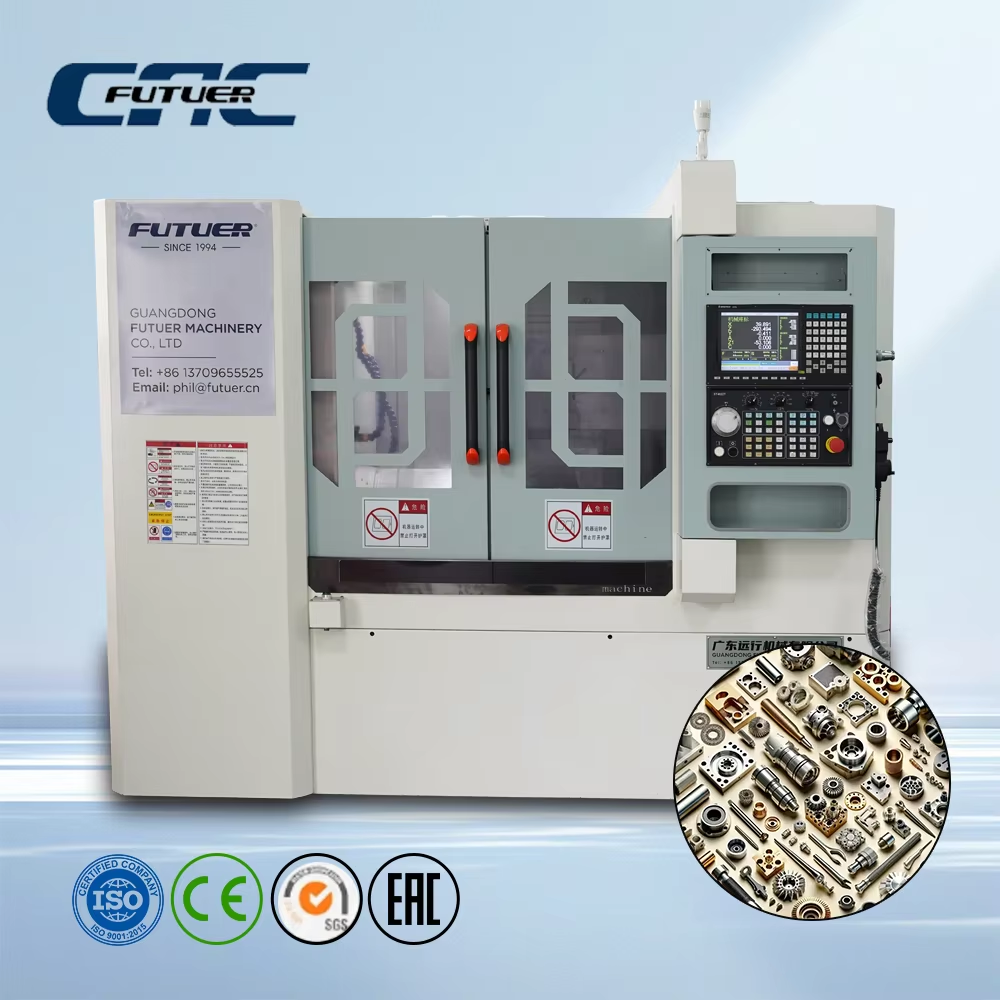
Superior Precision and Repeatability with Fully Automatic CNC Turning
How Closed-Loop Control and Real-Time Feedback Ensure Sub-Micron Tolerance Consistency
Fully automatic CNC (Computer Numerical Control) turning machines achieve unprecedented precision through closed-loop control systems integrated with live sensor feedback. These systems continuously monitor tool position, cutting forces, thermal expansion, and vibration—enabling micro-adjustments mid-cut to hold dimensional tolerances within ±0.0001" (0.00254 mm). Real-time compensation corrects for thermal drift, tool wear, and mechanical deflection, delivering surface finishes under Ra 0.4 μm without secondary finishing. In-process probing and automated optical verification ensure geometric compliance—detecting deviations instantly and eliminating reliance on post-process inspection.
Precision Comparison: Manual vs. Semi-Automatic vs. Fully Automatic CNC Turning Machine Performance
| Accuracy Metrics | Manual Lathes | Semi-Automatic CNC | Fully Automatic CNC |
|---|---|---|---|
| Positional Repeatability | ±0.005" | ±0.001" | ±0.0002" |
| Diameter Consistency | 99.2% | 99.7% | 99.99% |
| Taper/Tolerance Errors | High Risk | Moderate Risk | <2 ppm Defect Rate |
AI-driven predictive calibration and linear motor drives eliminate manual intervention entirely—ensuring phase repeatability and geometric fidelity unmatched by conventional machining. As documented in the 2023 IMTMachining Study, fully automated systems reduced scrap rates by 62% and inspection time by 85% compared to semi-automatic CNC turning machines.
Unmatched Production Efficiency and Reduced Cycle Times
Upgrading to a fully automatic CNC turning machine delivers dramatic throughput gains by eliminating idle time, consolidating operations, and streamlining changeovers.
Unmanned Operation, Multi-Tasking, and Minimal Setup Downtime
Lights-out manufacturing enables continuous, operator-free production: raw stock loading, multi-operation machining (turning, milling, drilling), in-cycle tool wear monitoring, real-time compensation, and finished-part unloading—all executed autonomously. This reduces cycle times by up to 50% versus semi-automatic models. Multi-tasking spindles and live tooling perform complex geometries in a single setup, eliminating inter-machine handling. Integrated probing and auto-tool-setting cut job changeover from hours to minutes—even across high-mix part families. The result is consistent output increases of 30–40% within existing floor space and energy use, significantly boosting overall equipment effectiveness (OEE) and lowering cost per unit.
Labor Optimization, Safety, and Operational Consistency
Reducing Human Error and Variability Through Programmable, Repeatable CNC Turning Machine Workflows
Fully automatic CNC turning replaces subjective, skill-dependent execution with deterministic, program-controlled workflows. Once validated, every cycle replicates identical spindle speeds, feed rates, tool paths, and dwell times—removing variability from fatigue, distraction, or inconsistent technique. Real-time sensors detect emerging anomalies—such as progressive tool wear or thermal deviation—and trigger automatic parameter adjustments before defects form. Operators shift from reactive oversight to proactive process stewardship: optimizing programs, analyzing quality data, and improving system performance. This transition enhances workplace safety, improves consistency, and strengthens quality culture.
Long-Term ROI: Staff Reallocation Savings vs. Predictable Maintenance Costs
While initial investment in fully automatic CNC turning exceeds that of manual or semi-automatic equipment, long-term ROI is robust and well-documented. A single skilled operator can effectively manage multiple automated cells—reducing direct labor cost per part by up to 60%. Freed capacity is redirected toward higher-value activities: CNC programming, statistical process control, root-cause analysis, and continuous improvement initiatives. Meanwhile, scheduled maintenance—guided by IoT telemetry and predictive analytics—is far more predictable than the hidden costs of manual operation: rework, scrap, unplanned downtime, and quality escapes. Over a three-to-five-year horizon, labor reallocation savings consistently exceed maintenance expenditures—delivering measurable net financial benefit and operational resilience.
Seamless Industry 4.0 Integration for Future-Proof CNC Turning
IoT Connectivity, AI-Driven Predictive Maintenance, and Live Tooling in High-Mix Environments
Modern fully automatic CNC turning machines serve as intelligent nodes within an Industry 4.0 ecosystem. Embedded IoT sensors stream real-time data—including spindle load, vibration spectra, coolant temperature, and axis positioning accuracy—to centralized analytics platforms. AI models analyze this data to forecast tool degradation, bearing wear, and thermal drift—triggering maintenance alerts before performance degrades or defects occur. In high-mix environments, live tooling, rapid automated tool changers, and adaptive feed/speed control maintain micron-level precision across frequent geometry and material changes. Combined with closed-loop feedback, cloud-based monitoring enables dynamic parameter optimization per batch—minimizing downtime, reducing scrap, and increasing responsiveness. For manufacturers producing dozens of part numbers daily, this integration transforms the CNC turning machine from a standalone asset into a self-aware, adaptive component of a fully digital, scalable production network.
FAQ Section
What is a closed-loop control system in CNC turning? It is a system that uses continuous sensor feedback to monitor tool position, forces, and thermal expansion, allowing real-time adjustments to maintain sub-micron precision.
How does fully automatic CNC turning help reduce cycle times? These machines enable unmanned operation, multi-tasking, and real-time adjustments, which streamline operations, cut idle time, and simplify changeovers.
What is the ROI potential for fully automatic CNC turning? ROI comes from reduced labor costs, minimized downtime, predictive maintenance, and enhanced operational efficiency over the long term.
Can fully automatic CNC machines integrate with Industry 4.0 systems? Yes, they are equipped with IoT sensors and AI-driven analytics to connect seamlessly with digital production networks.