
 EN
EN
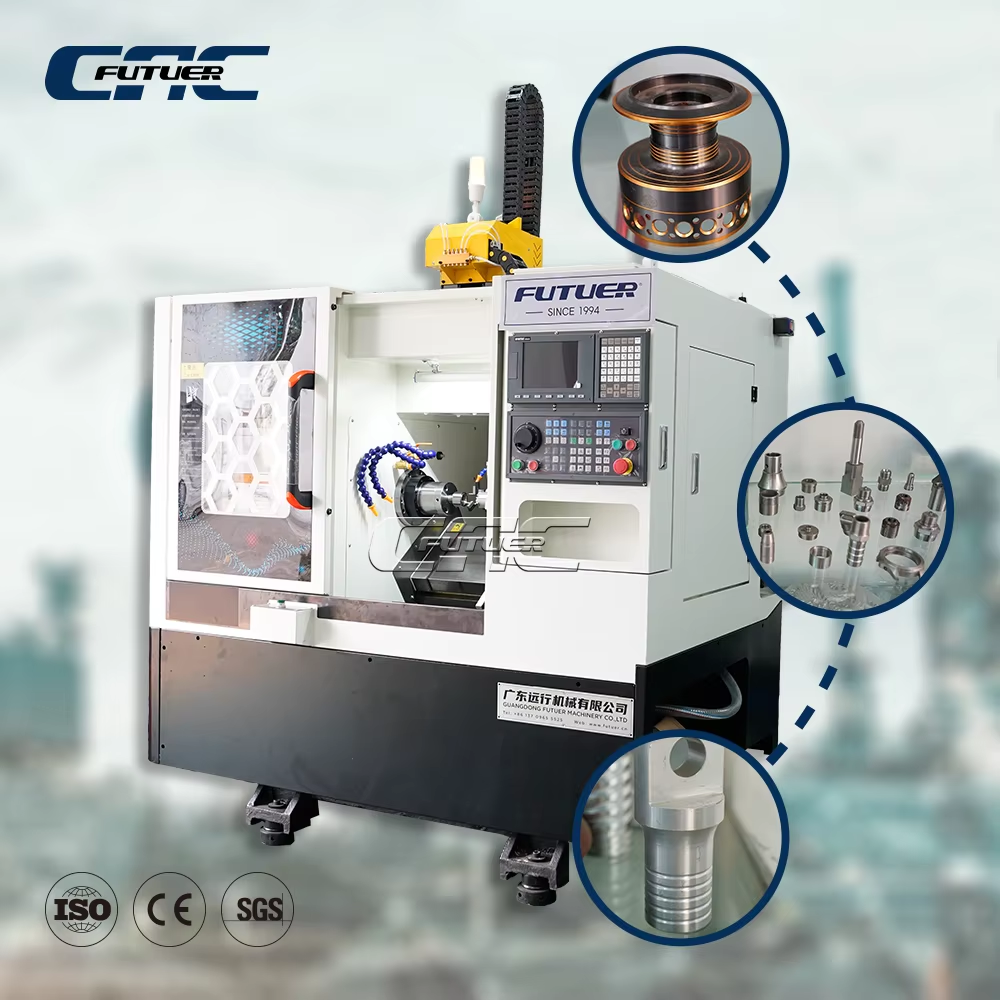
Syntec Lathe Systems: Core Architecture for Sub-Micron Accuracy
Every Syntec lathe is built on a control architecture engineered to hold tolerances below one micron. This foundation rests on two interdependent subsystems: a dual-loop feedback mechanism that cancels positional drift during high-speed cuts, and an intelligent thermal compensation network that corrects heat-induced errors in real time. Together, they transform a standard CNC turning center into a precision-critical production asset.
Dual-Loop Control Architecture: Eliminating Positional Drift in High-Speed Turning
High-speed turning generates centrifugal forces and tool-tip vibrations that can destabilize single-loop systems. Syntec’s dual-loop architecture resolves this by combining a coarse encoder on the motor with a fine-resolution linear scale mounted directly on the machine slide. The coarse loop tracks motor rotation; the fine loop reads actual slide position every microsecond. When discrepancies arise between the two signals, the controller instantly recalculates motor torque to restore alignment—ensuring the tool follows the commanded path with no cumulative drift. This enables repeatable roundness within 0.5 µm even at spindle speeds exceeding 8,000 rpm, meeting the most stringent aerospace and medical specifications.
Integrated Thermal Compensation: Real-Time IR Sensing and PLC-Driven Error Correction
Heat from cutting, spindle bearings, and coolant causes uneven thermal expansion across the machine frame—shifting the tool tip by several microns. Syntec counters this with embedded infrared (IR) sensors at critical points along the headstock, tailstock, and turret. These feed real-time temperature data to the PLC, which runs an axis-specific predictive model of thermal growth. Based on this, the system dynamically adjusts axis offsets before expansion affects part geometry. During a 45-minute titanium turning cycle, for example, diameter drift drops from 8 µm to under 1 µm—enabling first-article parts to meet print without manual intervention or warm-up delays.
Accuracy Validation: Measurable Gains in Critical Industries
Aerospace Case: Achieving <3 µm Roundness on Titanium Turbine Shafts
Titanium turbine shafts demand extreme roundness stability due to material hardness and heat retention. A leading aerospace tier-one supplier achieved consistent sub-3 µm roundness using a Syntec lathe—directly attributable to its rigid mechanical design, high-torque spindle, and instantaneous vibration damping. This level of accuracy is essential for components operating under high centrifugal loads, where deviations beyond a few micrometers accelerate bearing wear. The system maintained this tolerance across full production batches, validating its readiness for safety-critical aviation applications.
Medical Device Success: 99.8% First-Pass Yield with Syntec 64M Lathe
In orthopedic implant manufacturing—governed by ISO 13485—regulatory compliance hinges on part consistency and minimal rework. A contract manufacturer implemented the Syntec 64M control platform for complex knee joint components previously requiring extensive manual finishing and inspection. With in-process automation and closed-loop accuracy assurance, the facility achieved a 99.8% first-pass yield. Nearly every part met specification straight off the machine, eliminating secondary rework, reducing scrap, and accelerating final assembly—demonstrating the platform’s capability to support Class II and Class III medical device production.
Simplified CNC Programming via Syntec Lathe SmartCAM Ecosystem
Intelligent G-Code Generation: Reducing Operator-Induced Errors by 68%
Conventional CNC programming demands deep expertise in numerical logic, increasing the risk of costly setup errors. Syntec’s SmartCAM ecosystem replaces complex syntax with graphical toolpath simulation and plain-language programming. Operators sketch desired geometry and define actions using intuitive, natural-language prompts—bypassing manual entry of fixture offsets or material behavior assumptions. Default parameters for common operations are pre-validated, minimizing accidental overrides. Pilot deployments show a 68% reduction in operator-induced faults, translating to fewer scrap setups and significantly less unplanned downtime.
In-Process Touch-Probe Automation: Cutting Manual Re-Setup Time by 70%
Manual verification between turning passes adds labor, time, and variability. Syntec’s integrated touch-probe automation eliminates this bottleneck: immediately after each toolpath completes, the sensor inspects critical diameters and surfaces. If deviations exceed tolerance windows, the correction module automatically revises subsequent tool positions—no operator input required. This closed-loop validation reduces manual re-setup time by 70%, particularly benefiting intricate parts requiring multiple re-fixturing steps. In mass-manufacturing environments, it delivers measurable savings in both labor cost and cycle time.
FAQ
What is the Syntec dual-loop control architecture?
Syntec’s dual-loop control architecture combines a coarse encoder on the motor with a fine linear scale on the machine slide. This eliminates positional drift, ensuring precise tool positioning even at high spindle speeds.
How does Syntec address thermal expansion issues in lathes?
Syntec uses embedded infrared (IR) sensors and a predictive model in the PLC to adjust axis offsets dynamically, preventing heat-induced errors from affecting part geometry.
What industries benefit most from Syntec lathe systems?
Key industries include aerospace, medical device manufacturing, and precision engineering sectors that demand tight tolerances and high accuracy.
How does the SmartCAM ecosystem reduce operator errors?
The SmartCAM ecosystem simplifies programming with graphical toolpath simulation and natural-language prompts, reducing operator-induced programming errors.
What operational benefits does the touch-probe automation offer?
The touch-probe automation minimizes manual re-setup time by 70%, enabling faster and more consistent production, particularly for complex parts.