
 EN
EN
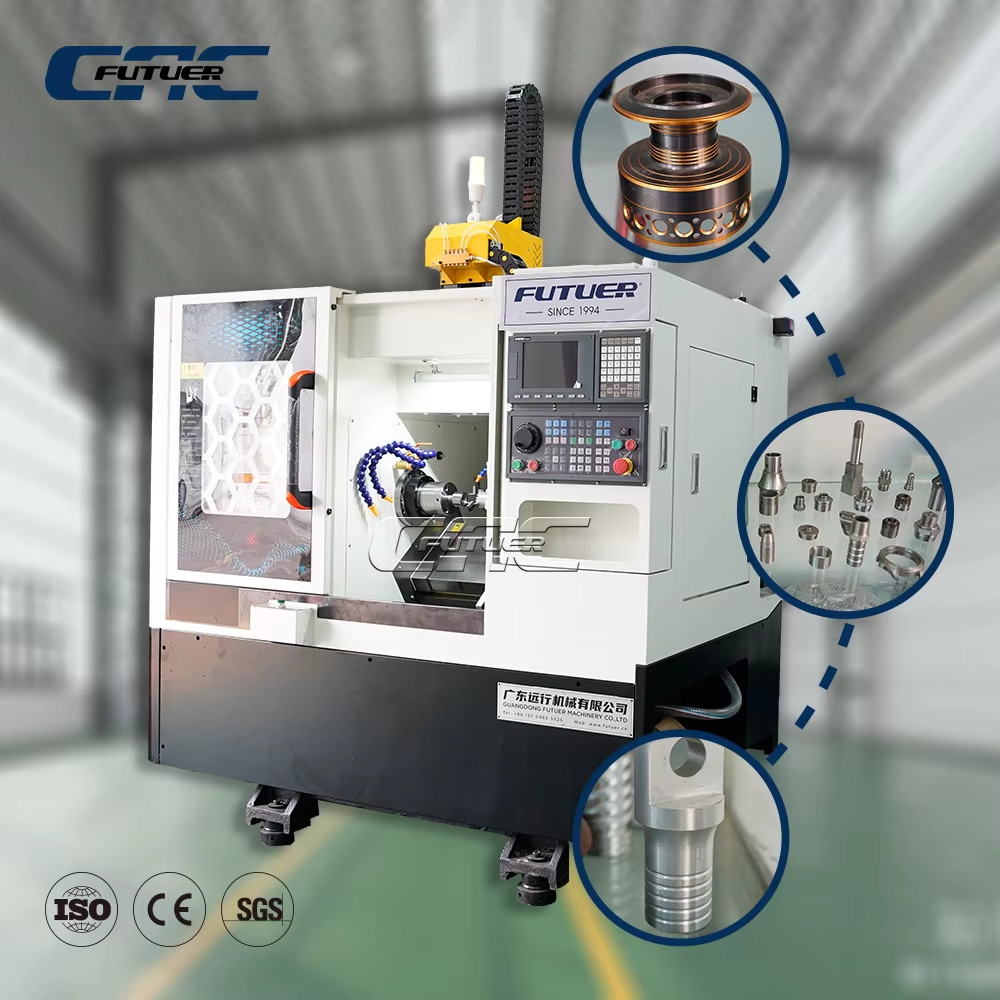
What Is a CNC Turning Machine and How Does It Work?
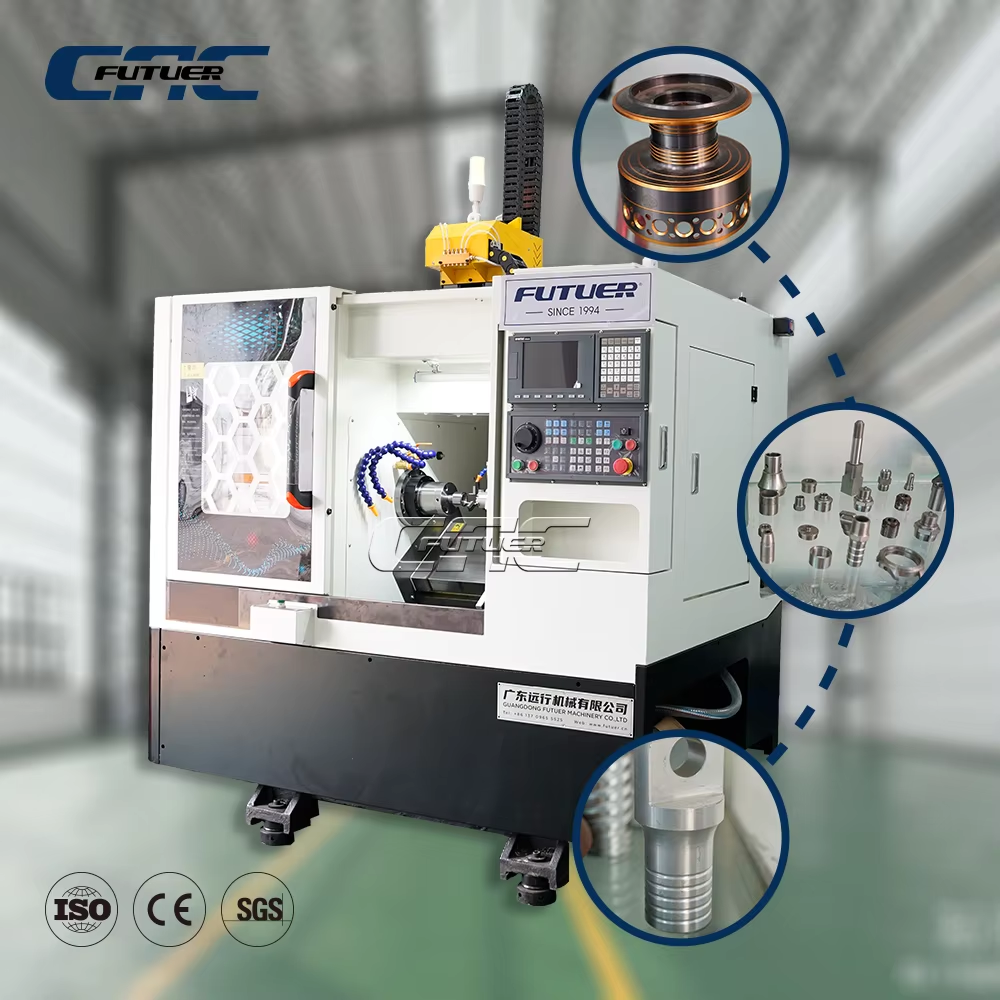
Core Components and Operational Principles
A CNC (Computer Numerical Control) turning machine is a precision subtractive manufacturing system in which a stationary cutting tool shapes a rotating workpiece—typically metal or plastic—to produce cylindrical, conical, or contoured parts like shafts, bushings, and flanges.
Key components include:
- Spindle: Drives workpiece rotation at programmable speeds (up to 6,000 RPM), directly influencing material removal rate and surface finish.
- Chuck: Secures the workpiece with high clamping force, critical for maintaining rigidity during high-speed, high-torque operations.
- Tool Turret: Holds multiple cutting tools (often 8–12 positions), enabling rapid tool changes and multi-operation sequences without manual intervention.
- Control Unit: Interprets G-code instructions to coordinate motion, speed, feed rate, and tool selection with micron-level accuracy.
The process achieves dimensional tolerances as tight as ±0.005 inches—and down to ±0.0005 inches in aerospace-grade setups—by precisely controlling tool engagement relative to the spinning stock.
Key Applications and Industry Use Cases for CNC Turning Machines
Aerospace, Automotive, and Medical Precision Parts
CNC turning machines deliver mission-critical performance across industries where precision, reliability, and regulatory compliance are non-negotiable.
In aerospace, they produce turbine shafts, landing gear fittings, and hydraulic manifolds requiring ±0.0005-inch tolerances and thermal stability under extreme operational stresses.
In automotive, they support high-volume manufacturing of transmission gears, brake calipers, and fuel injector bodies—achieving cycle times under 90 seconds while ensuring metallurgical consistency across batches.
In medical device manufacturing, they fabricate biocompatible titanium spinal rods, orthopedic fasteners, and surgical instruments with surface finishes below 0.4 μm Ra—critical for minimizing bacterial adhesion and meeting ISO 13485 requirements.
Together, these sectors account for over 68% of global precision-turned component demand, driven by zero-defect expectations and stringent standards from bodies like AS9100, IATF 16949, and FDA QSR.
High-Volume Production vs. Low-Volume Prototyping
CNC turning bridges the gap between mass production and agile prototyping.
For high-volume runs (>10,000 units), integrated bar feeders and robotic part handling enable lights-out operation—cutting per-part labor costs by up to 40% versus manual lathes and improving uptime through consistent feeding and reduced changeover time.
When dealing with small batches or prototype development, manufacturers can validate designs within just two days using quick change tooling systems, integrated CAD/CAM workflows, and modular fixtures. No need for expensive dedicated tooling investments either. The system scales really well too. Companies start with basic functional prototypes like those EV battery casings we've been seeing so much of lately, or even specialized medical implants such as hip joints. Then they move right into mass production without missing a beat. What's impressive is how consistent the results stay throughout different batch sizes. We're talking about maintaining tight tolerances around 0.001 inches regardless of whether it's a single unit or thousands produced at once.
Critical Selection Criteria for Industrial-Grade CNC Turning Machines
Spindle Speed, Tolerance, and Material Compatibility
Selecting the right CNC turning machine requires evaluating three interdependent technical criteria:
- Spindle Speed & Power: Higher RPMs (e.g., 4,000–6,000) optimize efficiency on aluminum and brass, while hardened steels and superalloys demand lower speeds with higher torque output. Confirm motor power ratings align with your dominant material mix.
- Tolerance Capability: Verify certified accuracy reports—not just advertised specs—for your required tolerance band (e.g., ±0.0005 inches for aerospace). Look for machines with thermal compensation and linear scale feedback for sustained metrological integrity.
- Material Versatility: Ensure chuck design, tooling interface, and coolant delivery support your full material range—from brittle ceramics and composites to galling-prone copper alloys and heat-resistant Inconel. Adaptive cooling systems are essential for maintaining dimensional stability across diverse thermal expansion profiles.
Automation Features: Bar Feeders, Tool Changers, and Live Tooling
Automation features define throughput potential and operational flexibility:
- Bar Feeders: Enable continuous unattended operation for long-run production—ideal when part lengths permit bar stock feeding. They reduce manual loading frequency and improve safety and consistency.
- Automatic Tool Changers (ATCs): A 12-position ATC cuts setup time by up to 70% compared to manual tool swaps, particularly valuable in job shops handling frequent part changes.
- Live Tooling: Integrated milling, drilling, and tapping spindles allow secondary operations in one setup, eliminating re-fixturing and preserving positional accuracy—especially vital for medical and aerospace components with tight coaxiality or perpendicularity requirements.
Prioritize servo-driven automation over pneumatic alternatives for longer service life and finer control—despite higher initial cost—when targeting >5 years of operational use.
Optimizing CNC Turning Machine Performance and ROI
Preventive Maintenance and Common Downtime Causes
Unplanned downtime remains the largest contributor to lost productivity—and cost—in CNC turning operations. According to the Ponemon Institute (2023), manufacturers lose an average of $740,000 annually due to unexpected stoppages. The top causes are:
- Tool wear (45% of interruptions)
- Coolant system failures (20%)
- Electrical or control system faults (15%)
Proactive strategies yield measurable returns: vibration analysis and thermal monitoring cut unplanned breakdowns by 60%; scheduled lubrication extends spindle service life by 2–3 years; and quarterly calibration ensures continued adherence to micron-level tolerances—particularly critical for regulated aerospace and medical production.
Programming Efficiency and Operator Training Best Practices
ROI acceleration depends as much on human capability as hardware capability. Skilled operators using modern CAM software reduce cycle times by 25% through intelligent toolpath planning—including minimized non-cut movements, adaptive feed rate control for variable stock conditions, and simulation-based collision avoidance.
According to research published in the Journal of Manufacturing Systems last year, companies implementing structured training programs see their setup times cut down by around 40 percent while also reducing scrap materials by about 18%. Training techs across multiple areas makes a big difference too. Those who learn G-code troubleshooting, how to configure live tools properly, and monitor processes through sensors tend to get better results from machines overall. Combine all this with smart programming approaches and regular maintenance checks, and most manufacturers report getting their money back within two years when running at high volumes. Some shops even recover costs sooner depending on their specific operations.
Future Trends: Smart CNC Turning Machines and Industry 4.0 Integration
Industry 4.0 is transforming CNC turning machines from standalone tools into intelligent nodes within connected manufacturing ecosystems. Embedded IoT sensors now monitor real-time parameters—including spindle load, vibration signatures, coolant flow, and surface temperature—feeding data to centralized analytics platforms.
Smart algorithms powered by artificial intelligence look at all this data coming in to spot when tools might fail before they actually do. They can automatically tweak cutting settings to get better surfaces or speed things up, which cuts down on unexpected stoppages somewhere around 45%. When it comes to cyber physical systems, these setups let machines talk directly to manufacturing execution systems, enterprise resource planning software, and even supply chain management platforms. This kind of connection makes it possible to adjust production schedules on the fly if materials run short, if quality checks flag issues, or when engineers need to make last minute changes to product specs.
Hybrid manufacturing—combining additive deposition with precision turning—expands design freedom for near-net-shape components with internal channels or lattice structures. Meanwhile, sustainability-focused features—like energy consumption dashboards and AI-optimized chip removal algorithms—reduce waste and support circular manufacturing goals without compromising precision.
Across aerospace, medical, and automotive sectors, these capabilities are shifting the paradigm from reactive production to predictive, adaptive, and fully traceable manufacturing—where agility, customization, and data-driven decision-making are standard.
FAQ
What is a CNC turning machine used for?
A CNC turning machine is used to shape a rotating workpiece, usually made of metal or plastic, into precise cylindrical, conical, or contoured parts.
How does CNC turning differ from traditional lathe machining?
CNC turning utilizes automated commands for precise and repeatable part creation, while traditional lathe machining requires manual adjustments and is subject to variability.
What industries benefit from CNC turning machines?
Industries such as aerospace, automotive, and medical device manufacturing benefit greatly due to the precision, reliability, and regulatory compliance these machines offer.
Table of Contents
- What Is a CNC Turning Machine and How Does It Work?
- Key Applications and Industry Use Cases for CNC Turning Machines
- Critical Selection Criteria for Industrial-Grade CNC Turning Machines
- Optimizing CNC Turning Machine Performance and ROI
- Future Trends: Smart CNC Turning Machines and Industry 4.0 Integration
- FAQ