
 EN
EN
Boosting Productivity with Multi-Axis CNC Turning Machines
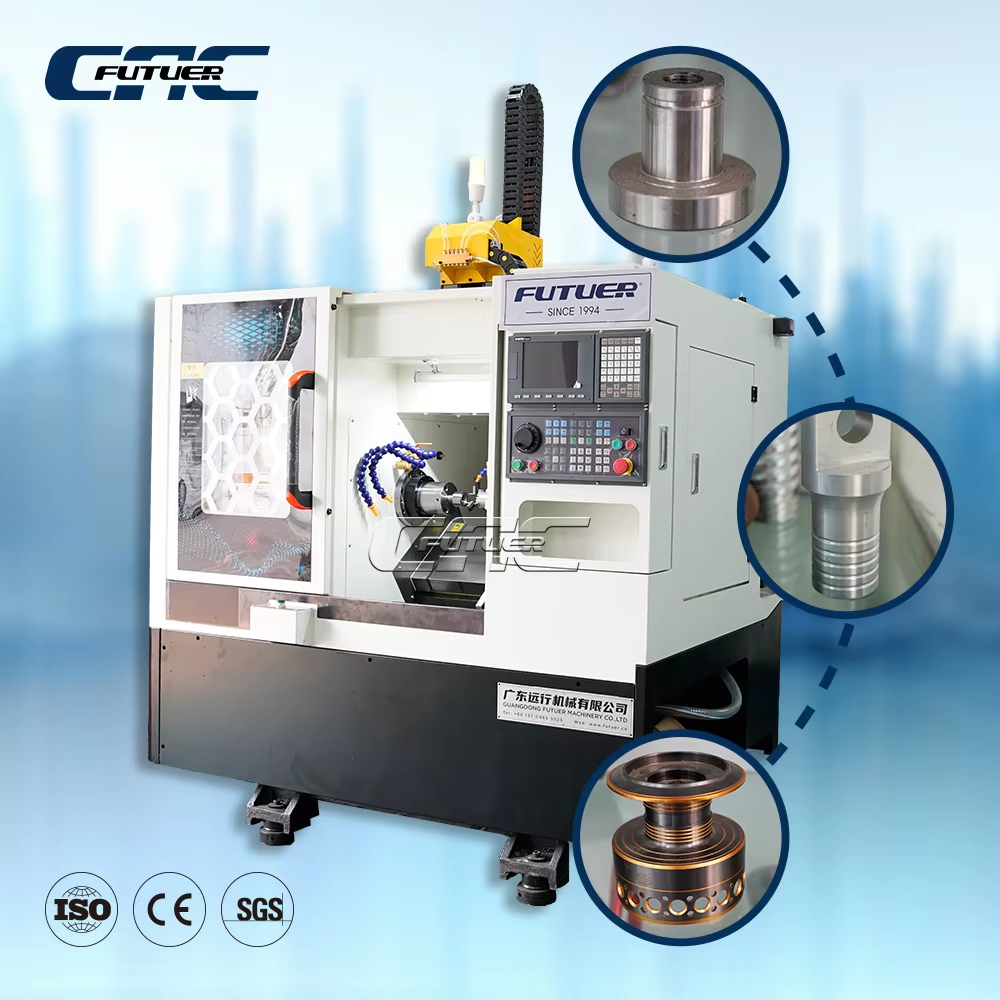
Computer Numerical Control (CNC) turning machines with multi-axis capabilities transform manufacturing by enabling complex operations in a single setup—directly enhancing output, efficiency, and part quality.
Single-Setup Multi-Operation Capability Eliminates Manual Handling and Reduces Lead Times
The multi axis CNC turning machines can do drilling, boring, contouring plus milling all while keeping the workpiece in place. No need to move parts around manually from station to station anymore. This cuts down on those annoying handling errors about 30% or so, and gets things done faster too. Lead times drop somewhere between 40 to 50% when making those super precise components. Take aerospace fittings as just one case study. These used to take several setups and could stretch out over days before completion. Now they're finished in just hours everything happens right there in a single chucking operation.
Automation-Driven Gains: Lights-Out Machining and Reduced Operator Dependency
These systems support unattended “lights-out” operation, running overnight with minimal supervision. Automation reduces operator dependency by 60–70%, freeing skilled staff for programming, optimization, and quality oversight—while throughput increases consistently. Real-time monitoring and adaptive control maintain dimensional stability, keeping error rates below 0.5% across extended runs.
Quantified Efficiency: 40–60% Reduction in Setup Time and 25–35% Shorter Cycle Times
The National Institute of Standards and Technology along with Manufacturing Technology Insights released a benchmark study in 2023 showing that multi-axis CNC turning machines can reduce setup time anywhere between 40 to 60 percent, while cutting down cycle times by about 25 to 35 percent when compared to traditional two-axis lathes. What makes this possible? Well, these advanced machines have better tool paths, they move multiple axes at once, and they don't need those extra fixtures that slow things down. All of this adds up to getting products to market much faster, especially important for companies making custom or specialized components where every day counts.
Enhancing Design Flexibility Through Advanced CNC Turning Machine Capabilities
Multi-axis CNC turning machines expand design freedom by machining complex geometries—including undercuts, non-concentric contours, and multi-sided features—in a single setup. Live-tooling turning centers perform turning, milling, and drilling simultaneously, removing the need for costly secondary operations and reducing cumulative tolerancing errors by 30–45% versus multi-machine workflows.
Machining Complex Geometries in One Chucking: Undercuts, Non-Concentric Contours, and Multi-Sided Features
When the Y-axis and C-axis move together, manufacturers get complete access to parts without needing to reposition them after clamping. The system works by having motors spin the part constantly along the C-axis while cutting tools come in from different directions X for radial movement, Z for axial positioning, Y for vertical cuts, and even B-axis for those tricky compound angles. With this setup, shops can create things like internal grooves, cross drilled holes, weird shaped profiles that are off center, and all sorts of complex forms that would have been impossible back when people were still using old school lathes. For airplane makers specifically, these capabilities make sense because they allow companies to combine multiple components into single parts. According to numbers released by FAA last year, this kind of part consolidation saves around seven hundred forty thousand dollars per aircraft built.
Rapid Iteration Without Tooling Overhaul: Supporting Prototypes and High-Mix, Low-Volume Production
Changing digital paths instead of messing around with physical fixtures lets designers iterate much faster on their creations. When engineers tweak G-code programs they can experiment with different features or fine tune those pesky tolerances all while keeping things moving along the production line. According to some tests done by NIST, this approach cuts down how long it takes to get prototypes ready by anywhere between half to three quarters. Throw in automatic tool changers and those handy in process probes? These machines become pretty good at handling all sorts of small batch productions where each job might be slightly different. They scale up effortlessly too - going from just making one sample piece right through to producing thousand unit runs without needing any sort of recalibration whatsoever.
Integrating Turning with Milling and Y-Axis Motion in Modern CNC Turning Machines
Today's CNC turning machines go beyond what old school lathes could do by combining live tool milling with Y axis movement all in one machine. The turret holds rotating cutters that can drill holes, make slots, and even handle contour milling tasks without needing to move the part from its position. The Y axis is particularly handy for those tricky jobs like cutting keyways or working on parts with irregular shapes, since it allows machining away from center without having to reset everything. Putting these features together means fewer times operators have to set up new positions, which helps maintain better accuracy throughout the process. Shops that have adopted this technology report saving around 35 to 40 percent on production time according to various case studies across different manufacturing facilities.
By combining turning and milling in one operation, manufacturers achieve seamless transitions between processes—critical for precision-critical components like impellers, surgical instruments, and medical implants. The result is a 30% average reduction in lead times and near-elimination of handling-induced defects.
Key advantages of integrated Y-axis and milling:
- Single-setup complexity: Machine undercuts, flats, and cross-holes without rechucking
- Error minimization: Maintain micron-level tolerances by avoiding workpiece transfers
- Resource efficiency: Cut energy and labor costs through consolidated operations
This technological synergy transforms the CNC turning machine into a self-contained manufacturing cell—streamlining workflows while expanding what's design-feasible.
The Strategic Evolution: From 2-Axis Lathes to Fully Concurrent Multi-Axis CNC Turning Machines
Kinematic Advancement: How Simultaneous C, X, Z, Y, and B Axis Motion Enables True Concurrent Machining
Early 2-axis lathes were limited to simple rotational cuts using only X (radial) and Z (longitudinal) motion. Today's advanced CNC turning machines achieve true concurrent machining through synchronized movement across five axes:
- C-axis: Continuous, programmable workpiece rotation
- X, Y, Z axes: Radial, vertical, and longitudinal tool positioning
- B-axis: Tilted tool orientation for compound-angle access
The integration of kinematics makes it possible to perform turning, milling, drilling, and contouring all at once. This capability lets manufacturers create complex shapes like helical paths, off center features, and detailed 3D surfaces without having to reposition parts. Back when these tasks required anywhere from three to four different operations on separate machines, things were much slower. According to research published by NIST and MTI last year, modern systems can cut down setup times by about 40 to 60 percent. Production speeds also see improvements around 25 to 35 percent faster overall. These numbers make clear why multi axis CNC turning has become such a cornerstone technology for advanced precision manufacturing today.
FAQ
What are the key benefits of using multi-axis CNC turning machines?
Multi-axis CNC turning machines offer numerous benefits, including the ability to perform complex operations in a single setup, reducing manual handling errors by about 30%, decreasing lead times by 40-50%, enabling lights-out machining, reducing operator dependency, and enhancing overall efficiency.
How do multi-axis CNC machines enhance design flexibility?
These machines extend design flexibility by machining complex geometries in one setup, eliminating the need for multiple machines and secondary operations, and supporting rapid iteration for prototypes and high-mix, low-volume production.
How do the Y-axis and live tool milling work in modern CNC turning machines?
The Y-axis and live tool milling in CNC machines allow for simultaneous turning, milling, and drilling operations in one machine, increasing precision, reducing setup times, and cutting production costs by using consolidated operations.
What impact does the integration of multiple axes have on machinability?
The integration of multiple axes allows for true concurrent machining, enabling complex shapes to be formed without repositioning parts, which boosts production speeds and efficiency significantly.
Table of Contents
- Boosting Productivity with Multi-Axis CNC Turning Machines
- Enhancing Design Flexibility Through Advanced CNC Turning Machine Capabilities
- Integrating Turning with Milling and Y-Axis Motion in Modern CNC Turning Machines
- The Strategic Evolution: From 2-Axis Lathes to Fully Concurrent Multi-Axis CNC Turning Machines
- FAQ