
 EN
EN
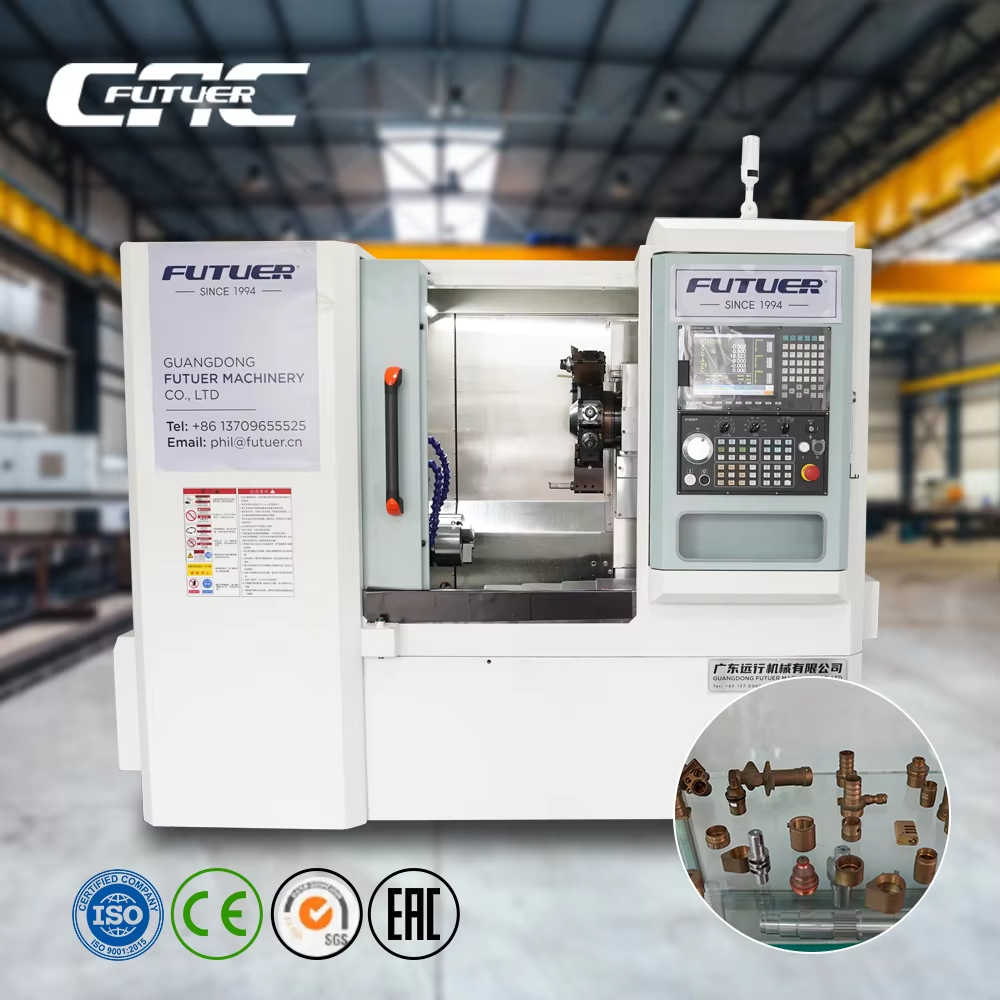
Superior Structural Rigidity and Load-Bearing Architecture
Optimized Bed Angle and Gravity-Aligned Load Path in Slant Bed CNC Lathe Design
The 30- to 45-degree slant bed geometry positions the tool axis parallel to gravitational forces—enabling cutting loads to follow a natural, gravity-aligned path into the machine foundation. This eliminates energy-wasting resistance found in horizontal designs and reduces structural deflection at the cutting interface. Cutting forces transfer directly through the hardened cast-iron bed via the shortest possible structural route, enhancing rigidity where it matters most: at the tool-workpiece contact point. (Figure 1: Force Distribution Diagram compares traditional horizontal vs. optimized slant angle mechanics).
Precision Performance Driven by Vibration Control and Thermal Stability
Damping Efficiency and Surface Finish Excellence (Ra ≤ 0.4 µm) in High-Speed Slant Bed CNC Lathe Operations
The slant bed’s rigid cast-iron foundation, combined with strategically placed internal ribbing and balanced mass distribution, delivers exceptional passive damping. Vibration amplitude is reduced by up to 80% compared to conventional horizontal lathes. As a result, operators consistently achieve surface finishes of Ra ≤ 0.4 µm at spindle speeds exceeding 6,000 RPM—without auxiliary dampening hardware. This inherent stability preserves toolpath fidelity during interrupted cuts on hardened alloys, minimizes insert chipping, and prevents micro-defects that compromise functional surfaces.
Reduced Thermal Deflection Under Sustained Cutting Loads
Slant bed architecture promotes symmetrical heat dissipation: coolant channels flank linear guideways, and thermal growth compensation algorithms activate automatically during extended cycles. Temperature drift remains within ±3 µm over an 8-hour production shift, thanks to uniform thermal loading across the tilted structure. Unlike horizontal beds—where heat accumulates asymmetrically near the spindle or ways—the slant design maintains consistent positioning accuracy across marathon runs. This reliability meets the stringent dimensional requirements of medical implants and aerospace components.
Gravity-Enhanced Chip Evacuation for Uninterrupted, High-Accuracy Machining
A slant bed CNC lathe leverages its angled structure—typically 30° to 75°—to create a natural gravity channel that directs chips away from the cutting zone. This design improves chip clearance by 40–60% compared to horizontal turning centers, where flat surfaces encourage accumulation and re-cutting.
40–60% Faster Chip Clearance vs. Horizontal Turning Centers—Minimizing Re-cutting and Workpiece Damage
Gravity-assisted flow accelerates chip movement to up to 2.5 m/sec, more than double the 1.2 m/sec typical of horizontal beds. Clogging incidents drop from once every 12 hours to once every 40 hours. This rapid evacuation prevents chip re-cutting—a primary contributor to heat buildup, surface roughness degradation, and accelerated tool wear. Industrial trials show reduced debris accumulation cuts manual cleaning downtime by 18 minutes per 8-hour shift, extends tool life by 15–20%, and supports surface finishes below 0.8 µm Ra, even during aggressive interrupted cuts on hardened materials.
Scalable Productivity: Handling Complex Parts, Larger Diameters, and Smart Automation
Extended X-Axis Travel and Spindle Rigidity Preservation for Large-Diameter Components
The 45-degree slant bed configuration enables longer X-axis travel without compromising structural integrity—making it ideal for large-diameter parts. The geometry also optimizes chuck-to-workpiece contact area, minimizing vibration transfer during heavy roughing passes. Combined with robust spindle mounting and reinforced bed cross-sections, this design sustains rigidity under high radial loads, reducing deflection risk and preserving tight tolerances on oversized components.
Seamless Integration with Bar Feeders, Robotic Loaders, and MES—Proven Uptime Gains in Aerospace and Medical Manufacturing
Modern slant bed CNC lathes are engineered for automation readiness—supporting plug-and-play integration with bar feeders, robotic loaders, and Manufacturing Execution Systems (MES). Real-time data exchange enables predictive maintenance, cycle optimization, and traceability. Documented case studies in aerospace and medical device manufacturing report 30–45% uptime improvements with fully integrated setups—driving throughput, consistency, and compliance without sacrificing precision.
Frequently Asked Questions (FAQs)
What is the advantage of slant bed CNC lathes over traditional designs?
Slant bed CNC lathes offer superior structural rigidity, optimized cutting force transfer, enhanced vibration damping, better thermal stability, faster chip clearance, and automation readiness, making them ideal for precision machining and high-performance applications.
How does the slant bed design reduce chip clogging?
By leveraging gravity-enhanced chip evacuation, slant bed CNC lathes direct chips away from the cutting zone, reducing chip clogging incidents and minimizing manual cleaning. This improved clearance leads to extended tool life, better surface finishes, and superior machining accuracy.
What industries benefit the most from slant bed CNC lathes?
Industries such as aerospace, medical devices, and precision component manufacturing benefit greatly due to the lathes’ ability to handle challenging materials, maintain tight tolerances, and integrate seamlessly into automated workflows.
Can slant bed CNC lathes handle large and complex parts?
Yes, the extended X-axis travel and robust spindle/mounting configurations make slant bed lathes ideal for machining large and complex components while maintaining dimensional accuracy under high load conditions.
Table of Contents
- Superior Structural Rigidity and Load-Bearing Architecture
- Precision Performance Driven by Vibration Control and Thermal Stability
- Gravity-Enhanced Chip Evacuation for Uninterrupted, High-Accuracy Machining
- Scalable Productivity: Handling Complex Parts, Larger Diameters, and Smart Automation
- Frequently Asked Questions (FAQs)